Table of Contents
1. Introduction
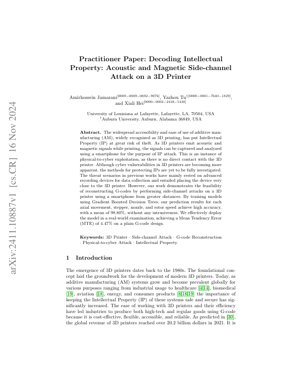
The proliferation of additive manufacturing (3D printing) has democratized production but introduced severe Intellectual Property (IP) vulnerabilities. This paper investigates a non-invasive, physical-to-cyber attack vector: exploiting the acoustic and electromagnetic side-channel emissions of 3D printers to reconstruct proprietary G-code instructions. Unlike prior work requiring specialized equipment and proximity, this attack leverages ubiquitous smartphone sensors, significantly lowering the barrier to entry for IP theft. The global 3D printing market, projected to reach $162.7 billion by 2030, makes this a critical security concern for industries from aerospace to biomedical engineering.
2. Threat Model & Attack Methodology
The attack assumes an adversary can place a smartphone within a plausible distance of a target 3D printer during operation. No physical tampering or network access is required.
2.1. Data Collection via Smartphone Sensors
The smartphone's built-in microphone captures acoustic signatures from stepper motors and moving parts, while its magnetometer records fluctuations in the local magnetic field generated by printer electronics. This multi-modal data collection creates a rich side-channel signal correlated with specific G-code commands (e.g., X/Y/Z axis movements, extrusion).
2.2. Feature Extraction & Signal Processing
Raw sensor data is processed to extract discriminative features. For acoustic signals, this may include Mel-Frequency Cepstral Coefficients (MFCCs), spectral centroids, and zero-crossing rates. Magnetic signals are analyzed for amplitude and frequency patterns corresponding to motor currents. The feature vector $\mathbf{F}$ for a time window $t$ is constructed as: $\mathbf{F}_t = [f_{a1}, f_{a2}, ..., f_{an}, f_{m1}, f_{m2}, ..., f_{mn}]$, where $f_a$ and $f_m$ represent acoustic and magnetic features, respectively.
3. Machine Learning Model & SCReG Technique
3.1. Gradient Boosted Decision Trees (GBDT)
The core of the attack is a supervised machine learning model. GBDT is an ensemble method that builds a strong predictive model by sequentially adding weak learners (decision trees) that correct the errors of previous ones. The model is trained on labeled data where feature vectors $\mathbf{F}_t$ are mapped to specific G-code command labels $y_t$ (e.g., "Move X-axis 10mm at speed S"). The objective is to minimize a loss function $L$, such as log loss: $L(y, \hat{y}) = -[y \log(\hat{y}) + (1-y) \log(1-\hat{y})]$ for binary classification, extended for multi-class.
3.2. Side-Channel Reconstruction of G-code (SCReG)
SCReG is the overarching technique. The trained GBDT model takes the stream of processed side-channel features and outputs a sequence of predicted G-code commands. This sequence is then assembled into a complete, reconstructed G-code file, effectively reverse-engineering the printing instructions.
Mean Prediction Accuracy
98.80%
Across axial movements, stepper, nozzle, and rotor speed predictions.
Mean Tendency Error (MTE)
4.47%
Error in reconstructed G-code for a plain design in real-world test.
Market Value (2030 Projection)
$162.7B
Global 3D printing market, highlighting the scale of the IP risk.
4. Experimental Results & Performance
4.1. Prediction Accuracy
The GBDT model achieved a remarkably high mean accuracy of 98.80% in classifying individual printer movements and operational parameters from the side-channel data. This demonstrates the strong correlation between physical emissions and digital commands.
4.2. Mean Tendency Error (MTE) & Real-world Test
The ultimate test is the fidelity of the reconstructed G-code. The authors define a Mean Tendency Error (MTE) metric, likely measuring the deviation in movement paths or extrusion amounts between the original and reconstructed code. On a "plain G-code design," the attack achieved an MTE of only 4.47%, indicating a highly accurate reconstruction capable of producing a near-identical physical object.
Chart Description: A hypothetical bar chart would show prediction accuracy (near 99%) for different G-code command categories (X-move, Y-move, Z-move, Extrude) on the y-axis, versus the command type on the x-axis. A second line graph would plot MTE percentage against increasing complexity of printed object designs, showing a likely increase in error for more complex geometries.
5. Technical Analysis & Framework
5.1. Mathematical Formulation
The attack can be framed as a sequence-to-sequence learning problem. Let the original G-code be a sequence $\mathbf{G} = [g_1, g_2, ..., g_T]$. The side-channel observation is a sequence $\mathbf{S} = [s_1, s_2, ..., s_T]$, where $s_t$ is the feature vector at time $t$. The model learns a mapping function $f_\theta$ parameterized by $\theta$ (GBDT weights) such that $\hat{\mathbf{G}} = f_\theta(\mathbf{S})$, minimizing the difference between $\mathbf{G}$ and $\hat{\mathbf{G}}$.
5.2. Analysis Framework Example
Case Study: Assessing IP Risk for a Small Manufacturing Firm
Step 1 (Signal Audit): Use a spectrum analyzer and magnetometer to profile the acoustic and EM emissions of the firm's 3D printer model during a benchmark print.
Step 2 (Vulnerability Mapping): Correlate distinct emission peaks/frequencies with specific G-code commands from the benchmark.
Step 3 (Attack Simulation): Simulate the data collection phase using a smartphone at various distances (1m, 3m, 5m) and noise levels.
Step 4 (Mitigation Planning): Based on results, recommend countermeasures: e.g., installing printer in a Faraday cage-lined enclosure (blocks magnetic signals) with acoustic damping panels, or implementing G-code obfuscation techniques that add random, non-functional movements to disrupt the signal-to-command mapping.
6. Discussion: Core Insight & Critical Analysis
Core Insight: This research isn't just another side-channel paper; it's a stark demonstration of how the convergence of ubiquitous sensing (smartphones) and powerful, accessible ML (GBDT via libraries like XGBoost) has democratized high-fidelity cyber-physical attacks. The real threat isn't the NSA, but a competitor with a phone in their pocket. The authors have effectively weaponized the inherent analog nature of digital manufacturing.
Logical Flow: The logic is compelling and frighteningly simple: 1) All physical actions leak information (acoustic, EM). 2) 3D printer actions are precisely controlled by G-code. 3) Therefore, the leak is a direct, noisy encoding of the G-code. 4) Modern ML is exceptionally good at denoising and decoding such patterns. The jump from "specialized lab equipment" to "consumer smartphone" is the critical inflection point the paper correctly highlights.
Strengths & Flaws:
Strengths: The practical demonstration with high accuracy is convincing. The use of MTE as an end-to-end metric for reconstruction quality is more meaningful than just classification accuracy. The focus on smartphone sensors makes the threat model highly realistic.
Flaws: The paper likely underestimates the challenge of scaling this attack to complex, multi-hour prints with support structures and variable layer heights. The "plain G-code design" test case is a best-scenario. Real-world prints involve continuous, non-linear toolpaths where error accumulation in the reconstructed sequence could become significant, a challenge noted in other sequence reconstruction tasks like those involving neural machine translation. Furthermore, countermeasures like active acoustic jamming or randomized delay insertion are not deeply explored. The work builds on established side-channel principles in hardware security but applies them in a novel, low-cost domain.
Actionable Insights: For industry, this is a wake-up call. Security can no longer be an afterthought in AM. Immediate actions: 1) Treat the printer's physical location as a security zone. 2) Develop "white noise" modules for printers that emit masking acoustic/EM signals. 3) Research G-code encryption or real-time obfuscation that preserves print geometry but alters the execution signature. For researchers, the next frontier is defending against these attacks using adversarial ML techniques—perhaps training models to recognize and filter out attempted reconstructions, similar to how generative adversarial networks (GANs) work, as pioneered by Goodfellow et al. in their seminal 2014 paper.
7. Future Applications & Research Directions
- Expanded Attack Vectors: Applying similar methodology to other CNC machines, industrial robots, or even keyboard acoustic eavesdropping in shared office spaces.
- Advanced Defense Mechanisms: Developing integrated hardware/software solutions that dynamically alter control signals to minimize predictable side-channel leakage, inspired by cryptographic constant-time implementations.
- Standardization of AM Security: Lobbying for industry-wide security standards for 3D printers, akin to those in the payment card industry (PCI DSS), mandating side-channel resistance.
- Federated Learning for Defense: Using federated learning across multiple printers to develop robust anomaly detection models for side-channel attacks without sharing sensitive operational data.
- Quantum Sensor Threats: Anticipating future attacks using emerging quantum-enhanced sensors capable of detecting even fainter electromagnetic signatures from greater distances.
8. References
- Jamarani, A., Tu, Y., & Hei, X. (2024). Decoding Intellectual Property: Acoustic and Magnetic Side-channel Attack on a 3D Printer. arXiv preprint arXiv:2411.10887.
- Goodfellow, I., Pouget-Abadie, J., Mirza, M., Xu, B., Warde-Farley, D., Ozair, S., ... & Bengio, Y. (2014). Generative adversarial nets. Advances in neural information processing systems, 27.
- Kocher, P., Jaffe, J., & Jun, B. (1999). Differential power analysis. Annual International Cryptology Conference (pp. 388-397). Springer, Berlin, Heidelberg.
- Yampolskiy, M., et al. (2016). Security of additive manufacturing: Attack taxonomy and survey. Additive Manufacturing, 11, 1-12.
- Wohlers Report 2023. (2023). Wohlers Associates. (Market projection data).
- National Institute of Standards and Technology (NIST). (2020). Cybersecurity Framework Manufacturing Profile. (Provides broader security context).