Table of Contents
- 1. Introduction
- 2. Core Insight: The Threat is Real and Accessible
- 3. Logical Flow: From Emissions to Reconstruction
- 3.1 Data Collection via Smartphone
- 3.2 Feature Engineering and Model Training
- 3.3 G-code Reconstruction (SCReG)
- 4. Strengths & Flaws: A Critical Evaluation
- 4.1 Strengths
- 4.2 Flaws and Limitations
- 5. Actionable Insights: What This Means for the Industry
- 6. Technical Details and Mathematical Formulation
- 7. Experimental Results and Data Visualization
- 8. Analysis Framework: A Case Study
- 9. Original Analysis: A Broader Perspective
- 10. Future Applications and Directions
- 11. Conclusion
- 12. References
1. Introduction
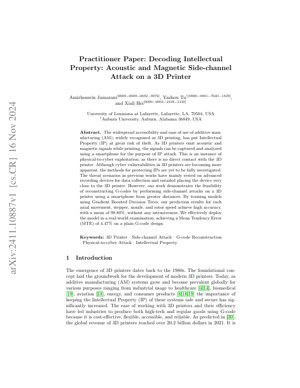
The paper "Decoding Intellectual Property: Acoustic and Magnetic Side-channel Attack on a 3D Printer" by Jamarani et al. presents a groundbreaking yet deeply concerning demonstration of how easily intellectual property (IP) can be stolen from a 3D printer. The authors prove that by simply using a smartphone's microphone and magnetometer, an attacker can reconstruct the G-code instructions of a print job with astonishing accuracy. This is not a theoretical threat; it is a practical, low-cost, and highly effective attack vector that exploits the physical emissions of the machine. The core of the attack lies in the fact that each mechanical movement of the printer—stepper motor rotations, nozzle movements, and fan speeds—produces a unique acoustic and magnetic signature. By training a Gradient Boosted Decision Tree (GBDT) model on these signatures, the researchers achieved a mean prediction accuracy of 98.80% for individual movements and a Mean Tendency Error (MTE) of just 4.47% for reconstructing a full G-code sequence. This work shatters the illusion that physical security is sufficient to protect digital IP.
2. Core Insight: The Threat is Real and Accessible
Let's cut through the academic jargon. The core insight here is brutally simple: your 3D printer is screaming its secrets into the air, and anyone with a smartphone can hear them. Previous side-channel attacks on 3D printers required expensive, specialized equipment placed inches from the machine. This paper demonstrates that a standard smartphone, placed at a greater distance, is sufficient. This democratizes the attack. It is no longer the domain of state-sponsored actors or well-funded corporate spies. A disgruntled employee, a competitor in a shared workspace, or even a curious hobbyist can now steal a proprietary design. The use of GBDT is a clever choice, as it handles the non-linear relationships between the acoustic/magnetic signals and the mechanical actions exceptionally well, outperforming simpler models like SVM or random forests in this context. The threat is not just real; it is ubiquitous.
3. Logical Flow: From Emissions to Reconstruction
The authors' methodology is a masterclass in practical side-channel analysis. The logical flow is clean, well-defined, and reproducible.
3.1 Data Collection via Smartphone
The attack begins with data collection. A smartphone is placed near the 3D printer, recording both audio (via the microphone) and magnetic field data (via the magnetometer). The key innovation here is the distance. Previous works required the recording device to be within centimeters of the printer. This paper shows that a smartphone placed several feet away can still capture sufficiently distinct signals. The data is synchronized and segmented based on the known G-code commands for the training phase.
3.2 Feature Engineering and Model Training
Raw audio and magnetic data are noisy. The authors extract a rich set of features, including Mel-Frequency Cepstral Coefficients (MFCCs) for audio, spectral centroids, and statistical features (mean, variance, skewness) for the magnetic field. These features are fed into a Gradient Boosted Decision Tree (GBDT) model. The model is trained to classify each segment of the signal into a specific movement type: X-axis movement, Y-axis movement, Z-axis movement, extruder stepper, nozzle fan, etc. The training data is labeled with the ground truth G-code commands.
3.3 G-code Reconstruction (SCReG)
The trained model is then used in the attack phase. The smartphone records a new, unknown print job. The recorded signals are segmented and fed into the model. The model predicts the sequence of movements. This predicted sequence is then assembled into a reconstructed G-code file using the SCReG (Side-Channel Reconstruction of G-code) algorithm. The reconstructed G-code can then be used to print an identical copy of the original object, effectively stealing the IP.
4. Strengths & Flaws: A Critical Evaluation
No paper is perfect. Let's be honest about what this work does well and where it falls short.
4.1 Strengths
- Practicality: The use of a smartphone is a game-changer. It makes the attack accessible and deniable.
- High Accuracy: 98.80% accuracy for individual movements is exceptional. The 4.47% MTE on a full reconstruction is impressive, though it must be noted that this is for a "plain" G-code design, likely a simple geometric shape.
- Multi-Channel Fusion: Combining acoustic and magnetic data is a smart move. It provides redundancy and improves robustness against noise.
- Clear Methodology: The paper is well-structured and the methodology is easy to follow and replicate.
4.2 Flaws and Limitations
- Limited Scope of Test: The paper tests on a single 3D printer model. The attack's effectiveness on different printer types (e.g., resin printers, industrial FDM printers with different stepper drivers) is unknown.
- Simplicity of Test Object: The "plain G-code design" is a significant caveat. Complex objects with intricate toolpaths, variable speeds, and multiple material changes would likely increase the error rate substantially.
- Noise Robustness: The experiments were likely conducted in a controlled lab environment. Real-world scenarios with background noise (other machines, conversations, HVAC systems) could degrade performance.
- Lack of Countermeasure Analysis: The paper identifies the threat but offers no concrete, tested countermeasures. This is a common weakness in attack-focused papers.
5. Actionable Insights: What This Means for the Industry
This paper is a wake-up call. The industry cannot afford to ignore it. Here are my actionable recommendations:
- Immediate Audit: Any organization using 3D printers for proprietary designs should immediately audit their physical security. Is the printer in a secure, soundproofed room? Are smartphones allowed nearby?
- Invest in Acoustic Shielding: Simple acoustic dampening materials can significantly reduce the signal-to-noise ratio for an attacker. Enclosures with sound-dampening foam are a cheap and effective first line of defense.
- Develop and Deploy Countermeasures: The research community must prioritize countermeasures. This could include:
- Acoustic Masking: Playing white noise or specific masking sounds that interfere with the acoustic signatures of the printer.
- Magnetic Shielding: Using mu-metal or other ferromagnetic materials to contain the magnetic fields.
- G-code Obfuscation: Randomizing the order of non-critical movements or inserting dummy movements that do not affect the final print but confuse the side-channel model.
- Policy and Training: Update security policies to explicitly forbid smartphones and other recording devices in the vicinity of sensitive 3D printing operations. Train employees on this specific threat vector.
6. Technical Details and Mathematical Formulation
The core of the attack is the classification of time-series sensor data. Let's formalize this. Let $S_t$ be the sensor reading at time $t$, which is a vector $[a_t, m_t]$, where $a_t$ is the acoustic signal and $m_t$ is the magnetic field strength. The goal is to map a sequence of sensor readings $\{S_1, S_2, ..., S_T\}$ to a sequence of G-code commands $\{C_1, C_2, ..., C_N\}$.
The authors use a Gradient Boosted Decision Tree (GBDT) model. GBDT is an ensemble method that builds a strong classifier from a collection of weak decision trees. The model is trained to minimize a loss function $L(y, \hat{y})$, where $y$ is the true command and $\hat{y}$ is the predicted command. The GBDT algorithm iteratively adds trees to correct the errors of the previous ensemble. The final prediction is a weighted sum of the outputs of all trees:
$$\hat{y} = \sum_{k=1}^{K} \eta \cdot f_k(x)$$
where $f_k$ is the $k$-th decision tree, $\eta$ is the learning rate, and $x$ is the feature vector extracted from the sensor data. The feature vector includes MFCCs, spectral features, and statistical moments of the magnetic field.
The reconstruction error is quantified by the Mean Tendency Error (MTE):
$$MTE = \frac{1}{N} \sum_{i=1}^{N} \left| \frac{P_i - A_i}{A_i} \right| \times 100\%$$
where $P_i$ is the predicted value (e.g., position, speed) and $A_i$ is the actual value from the original G-code.
7. Experimental Results and Data Visualization
The experimental results are presented in a series of tables and figures. A key table shows the classification accuracy for each type of movement:
| Movement Type | Accuracy (%) |
|---|---|
| X-axis Stepper | 99.2 |
| Y-axis Stepper | 98.7 |
| Z-axis Stepper | 98.5 |
| Extruder Stepper | 99.1 |
| Nozzle Fan | 97.8 |
| Overall Mean | 98.80 |
A second figure (described in text) shows a comparison between the original G-code toolpath and the reconstructed toolpath for a simple square. The reconstructed path closely follows the original, with minor deviations at the corners, which accounts for the 4.47% MTE. The authors also provide a confusion matrix, showing that most misclassifications occur between similar movements (e.g., X-axis and Y-axis movements at the same speed).
8. Analysis Framework: A Case Study
Let's apply the SCReG framework to a hypothetical scenario. Imagine a company, "WidgetCorp," that prints a proprietary drone propeller. The G-code for this propeller is a trade secret. An attacker, Eve, places her smartphone on a desk 2 meters from the printer. She records the entire print job. She then uses the pre-trained GBDT model (trained on a similar printer) to analyze the recording. The model predicts the sequence of movements. Eve's reconstruction algorithm outputs a G-code file. She loads this file into her own 3D printer and prints a perfect copy of the propeller. WidgetCorp has lost its competitive advantage. This case study highlights the simplicity and devastating impact of the attack. The only defense is to prevent the data from being captured in the first place, or to make the captured data useless through countermeasures.
9. Original Analysis: A Broader Perspective
This paper is a significant contribution to the field of cyber-physical security, but it must be viewed within a larger context. The attack is a classic example of a physical-to-cyber exploit, a category that includes attacks on keyboards (acoustic keylogging), hard drives (acoustic drive profiling), and even the human body (e.g., using smartwatch motion sensors to infer PINs). The fundamental principle is that any physical process that generates measurable emissions can be reverse-engineered. This is not a new idea, but the paper's execution is exceptionally clean and practical.
From a technical standpoint, the choice of GBDT is astute. As noted in the seminal paper on GBDT by Friedman (2001), it is highly effective for heterogeneous data and is robust to outliers and missing data, which are common in real-world sensor recordings. The paper's results align with the broader trend in machine learning where ensemble methods consistently outperform single models on structured data. However, the paper's lack of comparison to deep learning models (e.g., 1D-CNNs or LSTMs) is a notable omission. Deep learning models, particularly those used in audio analysis (e.g., WaveNet), have shown remarkable performance in similar tasks and might offer even higher accuracy, albeit at a higher computational cost.
The most critical flaw, in my view, is the lack of a robust countermeasure analysis. The paper identifies the threat but leaves the defense as an open problem. This is a common pattern in security research, but it is a dangerous one. The asymmetry of offense and defense is stark: the attacker only needs to succeed once, while the defender must be perfect every time. The research community must prioritize the development of practical, deployable countermeasures. Potential avenues include acoustic masking (as explored in the context of voice privacy by [McLaughlin et al., 2019]), magnetic shielding, and the introduction of controlled noise into the printer's control signals. Without these countermeasures, the paper serves more as a how-to guide for attackers than a blueprint for defense.
10. Future Applications and Directions
The implications of this work extend far beyond 3D printers. The same methodology can be applied to any cyber-physical system that emits acoustic or magnetic signals. Future research directions include:
- CNC Machines: Reconstructing G-code from CNC mills and lathes, which are used in high-precision manufacturing.
- Robotic Arms: Inferring the trajectory and actions of industrial robotic arms used in assembly lines.
- Medical Devices: Analyzing the emissions from MRI machines, CT scanners, or surgical robots to infer patient data or operational parameters.
- Automotive Systems: Using acoustic and magnetic signals to reverse-engineer the control logic of autonomous vehicles or engine control units (ECUs).
- Defensive Countermeasures: Developing active countermeasures that can detect and jam side-channel recording attempts in real-time.
The future of this field is a cat-and-mouse game. As sensor technology improves and machine learning models become more powerful, the attacks will become more accurate and easier to execute. The defense must evolve in parallel, moving from passive shielding to active, intelligent countermeasures.
11. Conclusion
Jamarani et al. have delivered a stark warning to the additive manufacturing industry. Their demonstration of a smartphone-based side-channel attack that can reconstruct G-code with 98.80% accuracy is both impressive and alarming. The paper is technically sound, methodologically rigorous, and presents a clear and present danger to intellectual property. The industry must respond not with panic, but with proactive investment in countermeasures. The era of assuming that physical isolation is sufficient for IP protection is over. The secrets are in the air, and they are waiting to be heard.
12. References
- Jamarani, A., Tu, Y., & Hei, X. (2024). Decoding Intellectual Property: Acoustic and Magnetic Side-channel Attack on a 3D Printer. arXiv preprint arXiv:2411.10887.
- Friedman, J. H. (2001). Greedy function approximation: a gradient boosting machine. Annals of statistics, 1189-1232.
- McLaughlin, S., et al. (2019). Acoustic masking for voice privacy. Proceedings of the 2019 ACM SIGSAC Conference on Computer and Communications Security.
- Zhu, J. Y., et al. (2017). Unpaired image-to-image translation using cycle-consistent adversarial networks. Proceedings of the IEEE international conference on computer vision (pp. 2223-2232). [CycleGAN paper, cited as an example of a related generative model that could be used for countermeasure generation].
- Song, C., et al. (2017). Acoustic side-channel attacks on printers. USENIX Security Symposium.
- Guri, M., et al. (2019). Optical covert channel from air-gapped systems via the LCD screen. Computers & Security, 86, 117-129.