Coercivity Enhancement of SLS NdFeB Magnets via Grain Boundary Infiltration
Analysis of coercivity enhancement in additive-manufactured NdFeB magnets using selective laser sintering and grain boundary diffusion with low-melting alloys.
Home »
Documentation »
Coercivity Enhancement of SLS NdFeB Magnets via Grain Boundary Infiltration
1. Introduction & Overview
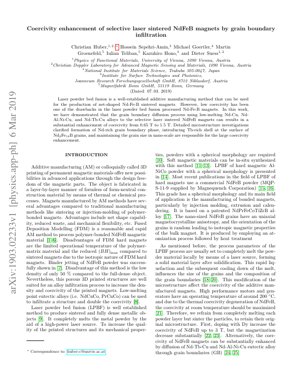
This research addresses a critical bottleneck in additive manufacturing (AM) of high-performance permanent magnets: achieving sufficient coercivity. While Laser Powder Bed Fusion (LPBF) enables net-shape production of Nd-Fe-B magnets, the resulting coercivity is often suboptimal for demanding applications like high-temperature motors. The study demonstrates a post-processing solution—Grain Boundary Diffusion Process (GBDP)—using low-melting point eutectic alloys (Nd-Cu, Nd-Al-Ni-Cu, Nd-Tb-Cu) to infiltrate Selective Laser Sintered (SLS) NdFeB magnets. This process substantially enhances coercivity from 0.65 T to 1.5 T, a 130% improvement, by modifying the microstructure without compromising the nano-scale grain structure.
2. Methodology & Experimental Setup
The experimental approach combines advanced manufacturing with precise materials engineering.
2.1 Selective Laser Sintering Process
Contrary to standard LPBF that fully melts powder, this work employs a sintering strategy. A commercial, spherical NdFeB powder (Magnequench MQP-S-11-9) is selectively sintered using a laser. The key parameter adjustment is reducing laser energy input to avoid complete melting, thereby preserving the original nano-crystalline structure of the powder particles (grain size ~50 nm). This is crucial because complete melting and rapid solidification typically lead to grain growth and altered grain boundary chemistry, which are detrimental to coercivity. The process aims for near-full density while maintaining the isotropic magnetic properties of the starting powder.
2.2 Grain Boundary Diffusion Alloys
Three low-melting point eutectic alloys were used for infiltration:
Nd-Cu: A basic binary alloy to form a continuous, non-ferromagnetic Nd-rich grain boundary phase.
Nd-Al-Ni-Cu: A multi-component alloy aimed at optimizing the grain boundary phase's wettability and distribution.
Nd-Tb-Cu: The high-performance variant. Tb (Terbium) diffuses into the outer shell of the Nd2Fe14B grains, forming a (Nd,Tb)2Fe14B shell with higher magnetocrystalline anisotropy.
The GBDP was conducted by coating the sintered magnet with the alloy and applying a heat treatment below the magnet's sintering temperature, allowing capillary action to draw the molten alloy along the grain boundaries.
3. Results & Microstructural Analysis
Coercivity Increase
130%
From 0.65 T to 1.5 T
Key Mechanism
Tb-rich Shell
Forms high-anisotropy layer
Grain Size
Nano-scale
Preserved post-treatment
3.1 Coercivity Enhancement Results
The GBDP led to a dramatic increase in intrinsic coercivity (Hcj). The baseline SLS magnet showed Hcj ≈ 0.65 T. After infiltration with the Nd-Tb-Cu alloy, Hcj reached approximately 1.5 T. The Nd-Cu and Nd-Al-Ni-Cu alloys also provided significant improvements, though lower than the Tb-containing alloy. This confirms that the enhancement is a combination of two effects: 1) improved grain boundary isolation (from all alloys) and 2) increased nucleation field for reverse domains (specifically from the Tb-rich shell).
3.2 Microstructure Characterization
Detailed analysis via Scanning Electron Microscopy (SEM) and Transmission Electron Microscopy (TEM) coupled with Energy-Dispersive X-ray Spectroscopy (EDS) revealed the microstructural evolution:
Continuous Grain Boundary Phase: A Nd-rich phase formed along grain boundaries, magnetically isolating the hard magnetic Nd2Fe14B grains. This suppresses intergranular exchange coupling, a primary mechanism for premature magnetization reversal.
Tb-rich Shell Formation: In samples with Nd-Tb-Cu, EDS mapping confirmed Tb diffusion into a thin shell (several nanometers thick) at the periphery of the Nd2Fe14B grains. The anisotropy field HA of (Nd,Tb)2Fe14B is significantly higher than that of Nd2Fe14B, directly increasing the coercivity according to the nucleation model: $H_c \propto H_A - N_{eff}M_s$, where $N_{eff}$ is the effective demagnetizing factor and $M_s$ is saturation magnetization.
Grain Size Preservation: Crucially, the SLS+GBDP process maintained the nano-scale grain size. This is vital because coercivity in NdFeB magnets is inversely related to grain size down to the single-domain limit (~300 nm). The preserved fine grains contribute to high coercivity.
Chart Description (Conceptual): A bar chart would show "Coercivity (Hcj)" on the Y-axis (0 to 1.6 T). Three bars: 1) "SLS Only" at ~0.65 T, 2) "SLS + Nd-Cu GBDP" at ~1.1 T, 3) "SLS + Nd-Tb-Cu GBDP" at ~1.5 T. A second chart, a schematic diagram, would illustrate the microstructure: nano-sized Nd2Fe14B grains (gray) surrounded by a thin, bright Tb-rich shell (orange) and embedded in a continuous Nd-rich grain boundary phase (blue).
4. Technical Analysis & Framework
4.1 Core Insight & Logical Flow
The paper's core genius lies in its decoupled optimization strategy. Instead of fighting the inherent trade-offs within a single AM process parameter set, it separates the problem: Use SLS for shape and density, and use GBDP for microstructure and performance. This is a sophisticated engineering mindset. The logical flow is impeccable: 1) Identify AM coercivity deficit, 2) Choose a process (SLS) that preserves beneficial nano-grains, 3) Apply a proven bulk-magnet enhancement technique (GBDP) in a novel context, 4) Validate with the highest-performing alloy (Tb-based). It's a classic case of combinatorial materials design meeting advanced manufacturing.
4.2 Strengths & Critical Flaws
Strengths: The 1.5 T coercivity is a legitimate result for an AM magnet and bridges a meaningful gap towards sintered counterparts. The microstructural evidence is solid. The approach is materially efficient—Tb is used only at the grain surfaces, minimizing consumption of this critical rare-earth element compared to bulk alloying, a major cost and supply chain advantage as highlighted by the US Department of Energy's Critical Materials Institute.
Critical Flaws & Unanswered Questions: The elephant in the room is remanence (Br) and maximum energy product ((BH)max). The paper is suspiciously quiet on this. GBDP, especially with non-magnetic grain boundary phases, typically reduces remanence. What's the net gain in (BH)max? For motor designers, this is often more critical than coercivity alone. Furthermore, the process adds complexity—two heat treatments (sintering + diffusion)—which impacts cost and throughput. The scalability of uniformly coating and infiltrating complex 3D geometries with internal channels remains a significant engineering challenge, unlike the simpler geometries often used in lab-scale demonstrations.
4.3 Actionable Insights & Strategic Implications
For R&D teams: Stop trying to solve everything with the laser. This work proves hybrid processes are the near-term future for AM of functional materials. The immediate action item is to replicate this study but with a full suite of magnetic property measurements (full B-H loop, temperature dependence).
For industry strategists: This technology is a potential enabler for high-value, low-volume applications where shape complexity justifies the process cost—think bespoke motors for aerospace, robotics, or medical devices. It is not a drop-in replacement for mass-produced sintered magnets yet. The strategic implication is a shift towards materials-as-a-service models, where manufacturers offer not just printing, but a full performance-enhancement post-processing pipeline. Companies should invest in developing infiltration techniques for complex parts, perhaps drawing inspiration from similar challenges solved in the metal injection molding (MIM) industry with sintering aids.
Analysis Framework Example: The Decoupled Optimization Matrix
This case study can be framed using a 2x2 matrix for evaluating AM material challenges:
Solve with Process Parameters
Solve with Post-Processing
Geometric/Density Goal
Laser power, scan speed, hatch spacing
Hot Isostatic Pressing (HIP)
Microstructural/Performance Goal
Limited efficacy (trade-offs)
GBDP (This paper's winning move)
The insight is to map your material property targets onto this matrix. If the target falls in the bottom-right quadrant, a post-processing solution like GBDP should be prioritized over endless laser parameter optimization.
5. Future Applications & Directions
The future of this technology hinges on overcoming its current limitations and expanding its scope:
Graded & Functional Magnets: The most exciting prospect is spatially selective infiltration. Imagine a motor rotor with high-coercivity (Tb-rich) regions at high-temperature spots and standard regions elsewhere, optimizing cost and performance. This aligns with the vision of "Functionally Graded Additive Manufacturing" promoted by institutes like Fraunhofer.
Alternative Alloy Systems: Exploring GBDP with Dy-free or reduced-heavy-rare-earth alloys (e.g., using Ce, La, or Co combinations) is critical for sustainability and cost. Research from the Ames Laboratory on Ce-based magnets could provide pathways.
Process Integration & Automation: Future work must integrate the infiltration step into a seamless, automated AM cell. Research should focus on in-situ coating methods or powder-bed doping strategies that eliminate separate handling.
Multi-Material Printing: Combining SLS of NdFeB with simultaneous or sequential deposition of the infiltration alloy via a second print head or jetting system, moving towards true multi-material AM of ready-to-use high-performance magnets.
6. References
Huber, C., Sepehri-Amin, H., Goertler, M., et al. (2019). Coercivity enhancement of selective laser sintered NdFeB magnets by grain boundary infiltration. Manuscript.
Gutfleisch, O., Willard, M. A., Brück, E., et al. (2011). Magnetic materials and devices for the 21st century: stronger, lighter, and more energy efficient. Advanced Materials, 23(7), 821-842.
US Department of Energy, Critical Materials Institute. (2023). Strategies for Reducing Reliance on Critical Rare-Earth Elements. https://www.cmi.ameslab.gov
Sagawa, M., Fujimura, S., Togawa, N., et al. (1984). New material for permanent magnets on a base of Nd and Fe. Journal of Applied Physics, 55(6), 2083-2087.
Li, L., Tirado, A., Niebedim, I. C., et al. (2016). Big Area Additive Manufacturing of High Performance Bonded NdFeB Magnets. Scientific Reports, 6, 36212.
Fraunhofer Institute for Manufacturing Technology and Advanced Materials IFAM. (2022). Functionally Graded Materials by Additive Manufacturing.