Table of Contents
1. Introduction & Overview
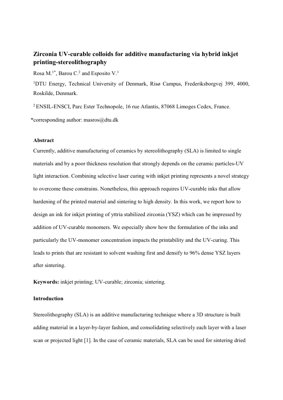
This research addresses a critical bottleneck in ceramic additive manufacturing (AM): the trade-off between resolution and material versatility. Traditional Stereolithography (SLA) for ceramics, while capable of producing dense parts, is constrained by poor layer resolution (~10 µm) and is typically limited to single-material builds. Inkjet printing offers superior resolution (<1 µm layer) and multi-material capability but struggles to achieve the high ceramic densities required for functional components. The paper proposes a novel hybrid approach combining inkjet printing for precise material deposition with subsequent UV-curing (SLA) for consolidation, aiming to unlock high-resolution, multi-material ceramic AM.
2. Methodology & Experimental Design
The core challenge was formulating an ink that satisfies the conflicting requirements of both inkjet printing (low viscosity, Newtonian behavior) and SLA (UV-curability leading to a robust green body). The research focused on yttria-stabilized zirconia (YSZ), a high-performance ceramic.
2.1. Ink Formulation & Materials
The ink was based on a dispersion of YSZ particles in a solvent. The key innovation was the incorporation of a UV-curable monomer, Trimethylolpropane triacrylate (TMPTA), which acts as a structural binder. The concentration of TMPTA was the primary variable studied, as it directly impacts ink viscosity, droplet formation, and the degree of cross-linking upon UV exposure.
2.2. Hybrid Printing Process
The process flow involved: 1) Inkjet deposition of the YSZ-TMPTA colloid to form a thin, precise layer. 2) Immediate selective UV-curing of the deposited layer to polymerize the TMPTA, creating a solid, handleable green structure. 3) Layer-by-layer repetition to build the 3D object. 4) Final thermal debinding and sintering to burn out the polymer and densify the ceramic.
3. Results & Analysis
The study systematically evaluated the interplay between formulation, process, and final properties.
3.1. Printability & Viscosity
A critical finding was the existence of a "printability window" for TMPTA concentration. Too low, and the green strength was insufficient; too high, and the ink viscosity exceeded the limits for reliable jetting (typically < 20 mPa·s for piezoelectric printheads). The optimal formulation balanced these factors.
3.2. UV-Curing & Microstructure
The presence of ceramic particles scatters UV light, potentially inhibiting curing. The paper demonstrated that by optimizing the UV intensity and exposure time, complete through-thickness curing could be achieved even in particle-loaded inks, resulting in a homogeneous polymer-ceramic composite green body resistant to solvent washing.
3.3. Sintering & Final Density
The ultimate test was sintered density. The research successfully achieved YSZ layers with a density of approximately 96% of theoretical density. This is a significant result, indicating that the polymer burnout did not introduce critical defects and that the ceramic particle packing in the green state was sufficient for near-full densification.
Key Metric: Sintered Density
~96%
of theoretical density achieved
Layer Resolution Target
< 1 µm
via inkjet deposition
Core Challenge
Viscosity < 20 mPa·s
for stable inkjet printing
4. Core Insight & Logical Flow
Core Insight: The true innovation here isn't just a new material, but a systems-level rethinking of the ceramic AM workflow. The authors correctly identify that decoupling material deposition (inkjet) from consolidation (UV-cure) is the key to breaking the historical trade-offs. This mirrors the philosophy in other hybrid AM fields, like the work on multi-material bioprinting from the Wyss Institute, where separate printing and crosslinking steps enable complex, cell-laden structures. The logical flow is impeccable: define the problem (SLA limitations), propose a hybrid solution, identify the critical missing piece (a dual-purpose ink), and systematically de-risk it by studying the fundamental formulation-property relationships.
5. Strengths & Flaws
Strengths: The paper's greatest strength is its practical, problem-solving focus. It doesn't just present a novel ink; it maps the process window. The achievement of 96% density is a concrete, measurable success that moves the field from concept to credible prototype. The use of TMPTA is smart—it's a workhorse monomer with known reactivity, reducing unknown variables.
Flaws & Gaps: The analysis is somewhat myopic. It proves feasibility for thin layers, but the elephant in the room is 3D, multi-layer fabrication. How does curing depth vary with layer count? Does shadowing or oxygen inhibition become issues? The study is silent on the mechanical properties of the sintered parts—96% density is good, but what about strength, toughness, and Weibull modulus? Furthermore, while mentioning multi-material potential, it provides zero demonstration. Contrast this with seminal works in multi-material AM, like the MIT MultiFab system, which rigorously characterized interfacial bonding between dissimilar printed materials.
6. Actionable Insights & Future Directions
For R&D teams: Stop trying to force a single material to do everything. This research validates the hybrid path. Your immediate development roadmap should: 1) Scale the process vertically. The next paper must show a >1mm tall, functional 3D component (e.g., a micro-turbine). 2) Quantify mechanical performance. Partner with a materials testing lab immediately. 3) Explore a second material. Start simple—print a contrasting oxide (e.g., Al2O3) alongside YSZ to study interdiffusion and stress during sintering. The long-term vision should be graded or patterned ceramics for applications like solid oxide fuel cells (SOFCs) or multi-functional sensors, where the National Institute of Standards and Technology (NIST) has outlined clear needs for advanced ceramic manufacturing.
7. Technical Details & Mathematical Models
The printability of an inkjet fluid is often governed by the Ohnesorge number ($Oh$), a dimensionless parameter relating viscous forces to inertial and surface tension forces: $$Oh = \frac{\mu}{\sqrt{\rho \sigma D}}$$ where $\mu$ is viscosity, $\rho$ is density, $\sigma$ is surface tension, and $D$ is the nozzle diameter. For stable droplet formation, $0.1 < Oh < 1$ is typically required. The addition of TMPTA and YSZ particles directly affects $\mu$ and $\rho$, shifting the $Oh$ number. The UV-curing kinetics can be modeled by the Beer-Lambert law, modified for scattering: $$I(z) = I_0 e^{-(\alpha + \beta) z}$$ where $I(z)$ is intensity at depth $z$, $I_0$ is incident intensity, $\alpha$ is absorption coefficient, and $\beta$ is scattering coefficient from ceramic particles. This explains the need for optimized exposure to ensure curing through the layer.
8. Experimental Results & Chart Description
Figure 1 (Conceptual): Viscosity vs. TMPTA Concentration. The chart would show a sharp, non-linear increase in ink viscosity as TMPTA concentration rises. A shaded region between ~5-15 wt% TMPTA would indicate the "printability window," bounded above by the jetting viscosity limit (~20 mPa·s) and below by the minimum required for green strength. Figure 2 (Microscopy): Sintered Microstructure. SEM images would compare samples from inks with low, optimal, and high TMPTA. The optimal sample shows a dense, homogeneous microstructure with minimal pores and uniform grain size. The low-TMPTA sample exhibits large voids from poor green strength, while the high-TMPTA sample may show carbon residue or distorted geometry from excessive polymer burnout. Figure 3 (Graph): Density vs. Sintering Temperature. A plot showing bulk density increasing with temperature, plateauing near 1400-1500°C at ~96% theoretical density for the optimal ink, significantly higher than samples from non-optimal formulations.
9. Analysis Framework: A Case Study
Case: Developing a UV-curable Ink for Alumina. Step 1 - Parameter Definition: Define critical parameters: Target viscosity ($\mu < 15$ mPa·s), target sintered density ($>95%$), minimum green strength for handling. Step 2 - DOE (Design of Experiments): Create a matrix varying: Monomer type/conc. (e.g., TMPTA, HDDA), dispersant conc., ceramic loading (vol%). Step 3 - Characterization Cascade: 1. Rheology: Measure $\mu$, shear-thinning behavior. Calculate $Oh$ number. 2. Printability Test: Actual jetting to assess droplet formation, satellite generation. 3. Curing Test: UV exposure series, measure depth of cure via scratch test. 4. Green Body Analysis: SEM of fracture surface to check particle distribution. 5. Sintering & Final Analysis: TGA/DSC for burnout, sintering profile, final density (Archimedes), SEM for microstructure. Step 4 - Feedback Loop: Use results from Step 3 to refine the DOE in Step 2. The key is linking each final property (e.g., density) back to a formulation/process variable.
10. Application Outlook & Future Development
Short-term (1-3 years): High-resolution ceramic molds for micro-injection molding or casting. Biomedical applications like patient-specific dental crowns or bone scaffolds with controlled porosity, leveraging the layer-by-layer control. Medium-term (3-7 years): Functional graded materials (FGMs) in energy devices. For example, printing an SOFC with a dense electrolyte layer (YSZ) seamlessly graded into a porous anode layer (Ni-YSZ cermet). Multi-material piezoelectric sensors or wear-resistant coatings with patterned hardness. Long-term & Research Frontiers: Integration with computational design and AI for topology-optimized ceramic components that are impossible to make otherwise. Exploration of non-oxide ceramics (e.g., SiC, Si3N4) requiring more complex sintering atmospheres. The ultimate goal is a digital ceramic foundry, where a digital file directly leads to a high-performance, multi-material ceramic component without tooling.
11. References
- Griffith, M. L., & Halloran, J. W. (1996). Freeform fabrication of ceramics via stereolithography. Journal of the American Ceramic Society.
- Deckers, J., Vleugels, J., & Kruth, J. P. (2014). Additive manufacturing of ceramics: a review. Journal of Ceramic Science and Technology.
- Zhou, W., et al. (2013). Digital material fabrication using mask-image-projection-based stereolithography. Rapid Prototyping Journal.
- Lewis, J. A. (2006). Direct ink writing of 3D functional materials. Advanced Functional Materials.
- Derby, B. (2010). Inkjet printing of functional and structural materials. Annual Review of Materials Research.
- NIST (National Institute of Standards and Technology). (2022). Measurement Science for Additive Manufacturing. [Online] Available: https://www.nist.gov/programs-projects/measurement-science-additive-manufacturing
- Wyss Institute for Biologically Inspired Engineering. (2020). Multimaterial 3D Bioprinting. [Online] Available: https://wyss.harvard.edu/technology/multimaterial-3d-bioprinting/
- Isola, P., Zhu, J.-Y., Zhou, T., & Efros, A. A. (2017). Image-to-Image Translation with Conditional Adversarial Networks (CycleGAN). IEEE Conference on Computer Vision and Pattern Recognition (CVPR). (Cited as an example of a paradigm-shifting hybrid approach in a different field).