Table of Contents
1. Introduction & Overview
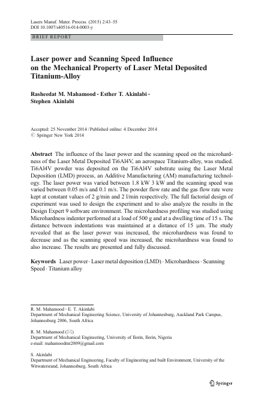
This report investigates the influence of two critical Laser Metal Deposition (LMD) process parameters—laser power and scanning speed—on the microhardness of Ti6Al4V, a premier aerospace titanium alloy. LMD, an Additive Manufacturing (AM) technology, enables the layer-by-layer fabrication or repair of complex components, offering a significant advantage over traditional subtractive methods for difficult-to-machine materials like titanium alloys. The study employs a structured full factorial Design of Experiment (DOE) to statistically analyze the parameter-property relationship, aiming to provide actionable insights for process optimization.
2. Methodology & Experimental Setup
The experimental approach was designed to isolate and quantify the effects of laser power and scanning speed on deposited material properties.
2.1 Materials and Equipment
Ti6Al4V powder was deposited onto a Ti6Al4V substrate using an LMD system. Key fixed parameters included a powder flow rate of 2 g/min and a gas flow rate of 2 l/min to ensure consistent material delivery and shielding.
2.2 Design of Experiment (DOE)
A full factorial DOE was implemented using Design Expert 9 software. The independent variables and their ranges were:
- Laser Power: 1.8 kW to 3.0 kW
- Scanning Speed: 0.05 m/s to 0.1 m/s
This design allows for the analysis of both main effects and interaction effects between the two parameters.
2.3 Microhardness Testing Protocol
Microhardness profiles of the deposited tracks were obtained using a microhardness indenter under the following standardized conditions:
- Load: 500 g
- Dwell Time: 15 seconds
- Inter-indentation Distance: 15 µm
This protocol ensured high-resolution mapping of hardness variations across the deposit.
Experimental Parameter Summary
Laser Power Range: 1.8 - 3.0 kW
Scanning Speed Range: 0.05 - 0.1 m/s
Constant Parameters: Powder Flow (2 g/min), Gas Flow (2 l/min)
Testing Load: 500 g (Vickers/Knoop)
3. Results & Analysis
The DOE analysis revealed clear and significant trends in how process parameters affect microhardness.
3.1 Effect of Laser Power
The study found an inverse relationship between laser power and microhardness. As laser power increased from 1.8 kW to 3.0 kW, the average microhardness of the deposited Ti6Al4V decreased. This is attributed to higher energy input leading to a larger melt pool, slower cooling rates, and potentially coarser microstructural features (like larger prior-beta grain size or wider alpha-lath spacing), which typically reduce hardness.
3.2 Effect of Scanning Speed
Conversely, a direct relationship was observed between scanning speed and microhardness. Increasing the scanning speed from 0.05 m/s to 0.1 m/s resulted in increased microhardness. Higher scanning speeds reduce the linear energy input ($E_l = P / v$, where $P$ is power and $v$ is speed), leading to a smaller melt pool, faster cooling rates, and a finer microstructure that enhances hardness.
3.3 Interaction Effects
The full factorial design allowed for the evaluation of interaction effects between power and speed. The results suggest that the effect of changing one parameter (e.g., increasing power to decrease hardness) can be modulated by the level of the other parameter (e.g., a concurrently high scanning speed may mitigate some of the hardness loss).
Key Insights
- To achieve higher microhardness, use lower laser power and higher scanning speed.
- The primary mechanism is control over thermal input and cooling rate, dictating microstructural refinement.
- DOE provides a statistical basis for this optimization, moving beyond trial-and-error.
4. Technical Details & Mathematical Models
The core relationship governing the thermal input in LMD is the linear energy density, often expressed as:
$$E_l = \frac{P}{v}$$
Where $E_l$ is linear energy density (J/m), $P$ is laser power (W), and $v$ is scanning speed (m/s).
While this study correlates power and speed directly to hardness, a more comprehensive model for predicting microhardness ($H_v$) could be developed via regression analysis from the DOE data, potentially taking the form:
$$H_v = \beta_0 + \beta_1 P + \beta_2 v + \beta_{12} P v + \epsilon$$
Where $\beta$ coefficients represent the main and interaction effects quantified by the software, and $\epsilon$ is the error term. This aligns with the structured approach seen in other AM process optimization studies, such as those for selective laser melting.
5. Key Insights & Discussion
The findings are consistent with fundamental metallurgical principles. Higher energy input (high power, low speed) promotes grain growth and reduces hardness, while lower energy input (low power, high speed) favors a finer, harder microstructure. This trade-off is critical for aerospace applications: components may require high hardness for wear resistance in some areas, but lower hardness/higher toughness in others. LMD, with its precise parameter control, is ideally suited for creating such functionally graded materials. The use of DOE elevates the work from a simple observation to a statistically validated process-property map.
6. Analyst's Perspective: Core Insight, Logical Flow, Strengths & Flaws, Actionable Insights
Core Insight: This paper successfully demystifies a critical but often opaque aspect of metal AM: it quantifies the inverse relationship between thermal input and as-deposited microhardness for Ti6Al4V in LMD. The real value isn't just in stating that "power down, speed up" increases hardness, but in providing the experimental data and statistical framework that turns a rule of thumb into a defensible process guideline. This is the kind of work that gets used on shop floors, not just cited in other papers.
Logical Flow: The authors' logic is admirably clean and industrial. They start with a known problem (Ti machining is hard), propose a solution (AM/LMD), identify key process knobs (power, speed), and systematically turn them to measure a key property (hardness). The use of DOE is the linchpin, transforming a series of experiments into a predictive model. The flow from hypothesis (parameters affect structure/properties) to method (DOE) to result (clear trends) to implication (process control) is textbook effective engineering research.
Strengths & Flaws: The major strength is its clarity and immediate utility. The controlled study with fixed powder/gas flow isolates the variables of interest beautifully. However, the flaw is one of scope—it's a narrow slice. The study focuses solely on microhardness, a single metric. In the real world, engineers balance hardness with tensile strength, fatigue resistance, ductility, and residual stress. As noted in the NASA Technical Reports Server (NTRS) on AM qualification, optimizing for one property often compromises another. The paper also doesn't delve into the underlying microstructural evidence (e.g., SEM images of grain size) to conclusively prove the mechanism, relying instead on well-established theory.
Actionable Insights: For process engineers, the takeaway is straightforward: use this study's parameter windows as a starting point for developing a "hardness dial." If a section of a part needs higher wear resistance, bias parameters towards lower power and higher speed within these ranges. Crucially, they must then validate other critical properties. For researchers, the next step is clear: expand the DOE to include other key responses (e.g., tensile strength, distortion) and build a multi-objective optimization model. Integrating real-time melt pool monitoring, as explored in recent work at institutions like Lawrence Livermore National Laboratory, could then allow for dynamic parameter adjustment to hit specific property targets layer-by-layer.
7. Analysis Framework & Case Example
Framework: This research exemplifies the "Process-Structure-Property" (PSP) framework central to materials science and advanced manufacturing. The framework can be visualized as a chain: Process Parameters (Input) → Thermal History → Microstructure (Grain size, phases) → Material Properties (Output, e.g., Hardness).
Non-Code Case Example: Repair of a Turbine Blade Airfoil
Scenario: A high-pressure turbine blade made of Ti6Al4V has suffered erosion at its tip.
Problem: The repaired region must match the base metal's hardness to avoid being a wear or fatigue weak point.
Application of Framework:
- Target Property: Define target microhardness (e.g., 350 HV).
- PSP Model: Use the findings of this study (and internal data) within the PSP framework. To achieve high hardness, the model dictates a fine microstructure, which requires high cooling rates.
- Process Parameter Selection: Based on the study's regression trends, select a parameter set leaning towards lower power (e.g., 2.0 kW) and higher speed (e.g., 0.09 m/s) to promote high cooling and fine grains.
- Validation & Calibration: Conduct a single repair pass on a test coupon. Measure the hardness. If it's off-target, adjust parameters iteratively (e.g., slightly lower power) following the DOE-predicted trend, effectively "walking" the PSP chain backward from property to process.
8. Future Applications & Research Directions
The principles established here have broad implications:
- Functionally Graded Materials (FGMs): Actively varying laser power and scanning speed along a deposition path to create components with spatially tailored hardness—soft, tough interiors with hard, wear-resistant surfaces in a single build.
- In-situ Property Control: Integration with machine learning and real-time sensor data (thermal imaging, pyrometry) to create closed-loop systems that dynamically adjust parameters to maintain desired microstructure and properties, akin to advanced process control in other industries.
- Multi-Objective & Multi-Parameter Optimization: Expanding the DOE to include other critical parameters (e.g., hatch spacing, layer height) and response variables (fatigue strength, fracture toughness, residual stress) to build comprehensive process maps for Ti6Al4V and other alloys.
- Repair Standardization: Developing certified "repair recipes" for specific aerospace components based on this foundational data, significantly reducing the qualification burden for LMD repair, a high-value application.
9. References
- Leyens, C., & Peters, M. (Eds.). (2003). Titanium and Titanium Alloys: Fundamentals and Applications. Wiley-VCH.
- Gibson, I., Rosen, D., & Stucker, B. (2015). Additive Manufacturing Technologies: 3D Printing, Rapid Prototyping, and Direct Digital Manufacturing (2nd ed.). Springer.
- DebRoy, T., Wei, H. L., Zuback, J. S., Mukherjee, T., Elmer, J. W., Milewski, J. O., ... & Zhang, W. (2018). Additive manufacturing of metallic components – Process, structure and properties. Progress in Materials Science, 92, 112-224.
- Frazier, W. E. (2014). Metal Additive Manufacturing: A Review. Journal of Materials Engineering and Performance, 23(6), 1917-1928.
- NASA Technical Reports Server (NTRS). (2020). Additive Manufacturing Qualification and Certification. Retrieved from [NASA Public Access].
- Lawrence Livermore National Laboratory. (2022). Advanced Manufacturing: Laser Powder Bed Fusion. Retrieved from [LLNL Manufacturing].
- Mahamood, R. M., Akinlabi, E. T., & Akinlabi, S. (2015). Laser power and scanning speed influence on the mechanical property of laser metal deposited titanium-alloy. Lasers in Manufacturing and Materials Processing, 2(1), 43-55. (Primary Source Analyzed)