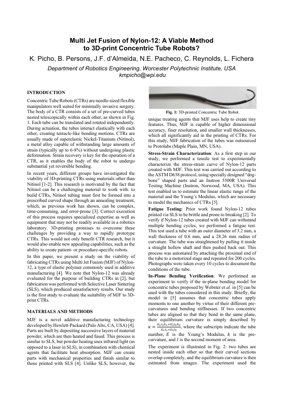
Multi Jet Fusion of Nylon-12 for 3D-Printed Concentric Tube Robots: A Feasibility Study
Investigates the viability of using Multi Jet Fusion (MJF) additive manufacturing with Nylon-12 to fabricate Concentric Tube Robots (CTRs) for minimally invasive surgery.
Home »
Documentation »
Multi Jet Fusion of Nylon-12 for 3D-Printed Concentric Tube Robots: A Feasibility Study
1. Introduction
Concentric Tube Robots (CTRs) are needle-sized, tentacle-like flexible manipulators composed of pre-curved, telescopically nested tubes, ideal for minimally invasive surgical (MIS) applications. Traditionally fabricated from superelastic Nitinol, CTRs face significant manufacturing hurdles: complex annealing processes, specialized equipment, and expertise requirements. This paper explores the viability of using Multi Jet Fusion (MJF) additive manufacturing with Nylon-12 polymer as an alternative to overcome these barriers, enabling rapid prototyping and patient-specific designs.
2. Materials and Methods
The study employed a multi-faceted experimental approach to evaluate MJF-printed Nylon-12 tubes for CTR applications.
2.1 Multi Jet Fusion (MJF) Technology
MJF, developed by Hewlett-Packard, is a powder-bed fusion process. It uses infrared energy and chemical agents (fusing and detailing agents) to selectively fuse nylon powder layer-by-layer. Compared to Selective Laser Sintering (SLS), MJF offers superior dimensional accuracy, finer resolution, and the ability to create thinner wall structures—critical attributes for fabricating the small, precise tubes required for CTRs. Fabrication was outsourced to Proto Labs.
2.2 Stress-Strain Characterization
Tensile tests were conducted per ASTM D638 standard using "dog-bone" specimens on an Instron 5500R Universal Testing Machine. The goal was to determine the linear elastic range and Young's Modulus ($E$) of MJF Nylon-12, essential parameters for modeling tube mechanics.
2.3 Fatigue Testing
To assess durability under cyclic bending—a key requirement for surgical robots—a fatigue test was performed. A tube (OD: 3.2 mm, wall: 0.6 mm, curvature radius: 28.26 mm) was repeatedly straightened inside a hollow shaft and released over 200 cycles using a motorized stage. Condition was documented photographically every 10 cycles.
2.4 In-Plane Bending Verification
An experiment was designed to test if the established elastic interaction model for concentric tubes (Webster et al.) applies to MJF Nylon-12 tubes. The model predicts the equilibrium curvature when two pre-curved tubes interact.
3. Results and Discussion
Key Experimental Metrics
Material Property: MJF Nylon-12 exhibited a consistent stress-strain profile within the tested range.
Fatigue Performance: The tube survived 200 full bending-straightening cycles without visible cracking or failure, a marked improvement over prior SLS results.
Model Validation: Preliminary data suggested the in-plane bending model could be applicable, though further validation with precise curvature measurement is needed.
The results indicate that MJF-processed Nylon-12 is significantly more resilient than its SLS counterpart, addressing a major flaw identified in earlier research [2]. The successful fatigue test suggests potential for reusable or multi-procedure prototypes. The ability to use established mechanical models would greatly simplify the design and control of polymer-based CTRs.
4. Technical Analysis and Core Insights
Core Insight: This paper isn't just about 3D printing a robot; it's a strategic pivot from materials-limited to design-led surgical robotics. The authors correctly identify that Nitinol's superelasticity, while ideal for performance, creates a high barrier to innovation (specialized annealing, low iteration speed). By proposing MJF+Nylon-12, they trade some material performance for massive gains in accessibility, iteration speed, and geometric freedom. This is a classic disruptive innovation pattern seen in fields like computer vision, where models like CycleGAN (Isola et al., 2017) traded some task-specific optimization for a general, learnable framework that unlocked new applications.
Logical Flow: The argument is methodical: 1) Establish CTR value and Nitinol's pain points. 2) Propose AM as a solution, acknowledging past SLS failure. 3) Introduce MJF as a superior AM process with relevant technical advantages (accuracy, thin walls). 4) Validate the new material-process combo through fundamental (tensile) and application-specific (fatigue, modeling) tests. The logic chain from problem to proposed solution to validation is clear and robust.
Strengths & Flaws:
Strength: The focus on fatigue is brilliant. For a surgical tool, one-time strength is less important than reliable performance over multiple actuations. Testing this directly speaks to real-world utility.
Strength: Outsourcing to Proto Labs adds commercial realism. It shows the pathway isn't locked to a proprietary academic printer.
Flaw: The study is conspicuously silent on sterilization. Can MJF Nylon-12 withstand autoclaving, gamma radiation, or chemical sterilants? This is a non-negotiable requirement for clinical use and a major potential showstopper.
Flaw: The "in-plane bending verification" is described but results are vague. Quantitative data on curvature accuracy vs. model prediction is missing, leaving a gap in the crucial argument of model transferability.
Actionable Insights:
For Researchers: This is a viable, low-capital-entry pathway into CTR prototyping. Prioritize follow-up studies on sterilization compatibility and long-term creep behavior of Nylon-12.
For Engineers: Explore MJF's design freedom. Can you print integrated channels for suction, irrigation, or fiber optics directly into the tube wall? This is where polymers could surpass metals.
For Industry (e.g., Intuitive Surgical): Monitor this closely. The real threat/opportunity isn't replacing the da Vinci's arms but enabling a new class of ultra-disposable, patient-specific, single-use steerable needles and catheters that could complement or disrupt current offerings.
In essence, the paper successfully proves feasibility but the journey to viability requires conquering the sterilization and long-term bio-stability mountains—challenges well-documented in the literature on medical polymers (e.g., Williams, D.F., "On the mechanisms of biocompatibility," 2008).
5. Mathematical Model and Technical Details
The mechanics of concentric tubes are governed by elastic interaction. For two tubes in the same plane, the equilibrium curvature $\kappa$ is derived from minimizing the total strain energy. A simplified form of the model referenced from Webster et al. [5] is:
$E_i$ is the Young's Modulus of tube $i$ (obtained from tensile tests).
$I_i$ is the second moment of area of tube $i$'s cross-section ($I = \frac{\pi}{64}(d_o^4 - d_i^4)$ for a tube).
$\kappa_i$ is the pre-curvature of tube $i$.
This equation shows that the final curvature is a stiffness-weighted average of the individual tube curvatures. Validating this model for Nylon-12 requires accurate measurement of $E$ and the actual achieved curvature $\kappa$ after interaction.
6. Analysis Framework: A Case Study
Scenario: Designing a patient-specific CTR for accessing a deep-seated brain tumor via a transnasal pathway. The path is highly curved and unique to the patient's anatomy.
Framework Application:
Imaging & Path Planning: Extract 3D trajectory from patient CT/MRI scans.
Kinematic Modeling: Discretize the path into a series of constant curvature arcs. Use the model in Section 5 to solve the inverse problem: determine the required pre-curvatures ($\kappa_1, \kappa_2, ...$) and lengths of a 3-tube robot to follow this path.
Structural Simulation (FEA): Perform Finite Element Analysis on the designed tubes to check stress concentrations during maximum bending, ensuring they remain within the elastic limit of MJF Nylon-12.
Fatigue Life Estimation: Based on the stress range from FEA and the material's S-N curve (needs further characterization), estimate the number of procedure cycles the tool could withstand.
Digital Fabrication: Send the finalized tube geometries directly to an MJF service bureau (e.g., Proto Labs). No tooling or annealing required.
Validation: Test the physical robot on a phantom model of the patient's anatomy.
This framework highlights the integrated workflow from imaging to physical prototype that MJF enables, drastically compressing the traditional design cycle.
7. Future Applications and Directions
The success of polymer-based CTRs opens several compelling avenues:
Disposable Surgical Instruments: Single-use, patient-specific steerable guides for biopsies, drug delivery, or electrode placement, eliminating cross-contamination risk and reprocessing cost.
Multi-Material & Functional Printing: MJF can potentially print with multiple materials. Future tubes could have stiff sections for stability and soft, compliant sections for navigation, or have radio-opaque markers printed in-situ.
Endoscopic Hybrid Tools: Ultra-thin CTRs printed as deployable tools from the working channel of standard endoscopes, enhancing their capability.
Research Acceleration: As the paper intends, low-cost rapid prototyping will allow more research groups to experiment with CTR designs, control algorithms, and novel applications beyond surgery, such as industrial inspection in confined spaces.
Key Research Gaps: Immediate future work must address sterilization methods, long-term stability in biological environments, and the development of comprehensive constitutive models for MJF Nylon-12 under cyclic bending and torsional loads.
8. References
Bergeles, C., & Yang, G. Z. (2014). From passive tool holders to microsurgeons: safer, smaller, smarter surgical robots. IEEE Transactions on Biomedical Engineering, 61(5), 1565-1576.
Gilbert, H. B., et al. (2016). Concentric tube robots: The state of the art and future directions. Robotics Research, 253-269.
Bedell, C., et al. (2011). The engineering of nitinol self-expandable stents: A review. Annals of Biomedical Engineering, 39(3), 1017-1029.
HP Inc. (2018). HP Multi Jet Fusion Technology. Technical White Paper.
Webster, R. J., & Jones, B. A. (2010). Design and kinematic modeling of constant curvature continuum robots: A review. The International Journal of Robotics Research, 29(13), 1661-1683.
Isola, P., et al. (2017). Image-to-image translation with conditional adversarial networks. Proceedings of the IEEE conference on computer vision and pattern recognition (pp. 1125-1134).
Williams, D. F. (2008). On the mechanisms of biocompatibility. Biomaterials, 29(20), 2941-2953.
ASTM International. (2014). ASTM D638-14: Standard Test Method for Tensile Properties of Plastics.