1. Introduction & Overview
This document analyzes the research paper titled "A Stereolithographically Fabricated Polymethacrylate Broadband THz Absorber" by Park et al. The work presents a novel approach to creating a broadband absorber for the terahertz (THz) spectral range (82-125 GHz) using stereolithography (SLA), an additive manufacturing technique. The core innovation lies in moving beyond the prevalent Fused Filament Fabrication (FFF) method, which suffers from limited resolution, to leverage SLA's superior precision for creating complex, effective THz optical components.
The absorber design features periodic pyramidal structures arranged along a space-filling Hilbert curve path, fabricated from a THz-transparent polymethacrylate resin. The study demonstrates that this SLA-fabricated absorber effectively attenuates incident THz radiation compared to a bulk reference sample, validating the potential of high-resolution 3D printing for advanced photonic and electromagnetic structures.
2. Core Analysis & Expert Interpretation
As an industry analyst focusing on advanced manufacturing and photonics, I see this paper not just as a technical report, but as a strategic pivot in the toolkit for THz system engineers. Let's dissect its value proposition through a critical lens.
2.1 Core Insight: The Resolution Gambit
The paper's fundamental bet is that spatial resolution is the primary bottleneck in additive manufacturing (AM) for THz optics. While FFF is cheap and material-versatile, its ~100 µm resolution is laughably coarse for THz wavelengths (~1 mm at 300 GHz, ~2.4 mm at 125 GHz). The authors correctly identify that surface roughness and stair-stepping artifacts from FFF create significant scattering losses and impedance mismatches, degrading performance. By switching to SLA, with its ~10 µm resolution, they are essentially buying "electromagnetic fidelity." This is a classic trade-off: sacrificing some material choice and cost for a leap in geometric accuracy. It's a bet that the performance gain outweighs the process complexity, a calculation every photonics integrator must make.
2.2 Logical Flow: From Constraint to Solution
The authors' logic is admirably linear: 1) THz systems need custom, often complex, geometries (like gradient-index lenses or metamaterials). 2) Traditional machining struggles with these shapes. 3) AM promises geometric freedom. 4) The dominant AM method (FFF) lacks the precision. 5) Therefore, explore a higher-precision AM method (SLA). 6) Validate with a canonical problem—a broadband absorber. The choice of a pyramidal Hilbert curve structure is smart: it tests SLA's ability to create sharp features (pyramid tips) and continuous, non-retractable paths (Hilbert curve), both challenging for FFF. The flow from problem identification (FFF's flaws) to solution validation (SLA-fabricated absorber works) is clear and compelling.
2.3 Strengths & Flaws: A Pragmatic Assessment
Strengths:
- Proof of Concept Clarity: The paper cleanly demonstrates that SLA can produce functional THz structures. The side-by-side comparison with a bulk sample is effective.
- Material Awareness: Using a known THz-transparent polymethacrylate (likely similar to PMMA) sidesteps the huge problem of material loss tangents in 3D printed plastics, a common pitfall.
- Design for Manufacturing: The geometry is tailored for SLA's layer-by-layer curing process, avoiding severe overhangs.
Flaws & Omissions:
- Narrowband Validation: Calling it "broadband" while testing only from 82-125 GHz (~43 GHz bandwidth) is generous. True broadband performance for THz, say 0.1-10 THz, remains unproven. Material dispersion will likely become a major issue.
- Lack of Quantitative Benchmarking: How does its absorption efficiency compare to a commercially available THz absorber (e.g., based on carbon-loaded foam)? Or to a perfectly matched layer (PML) in simulation? Without this, the "effectiveness" claim is qualitative.
- Scalability Silence: SLA build volumes are small. The paper is silent on how to scale this to large-area absorbers needed for chamber lining, a key application.
- Durability & Environmental Testing: No data on how the polymer absorber performs under thermal cycling, humidity, or mechanical stress—critical for real-world deployment.
2.4 Actionable Insights: The Path Forward
For R&D managers and engineers, here's the takeaway:
- Adopt SLA for Prototyping High-Fidelity THz Metamaterials: If you're designing metamaterial unit cells, frequency-selective surfaces, or sub-wavelength lenses where feature size is critical, start with SLA for your prototypes. It's your best shot at matching simulation to reality.
- Pressure Material Scientists: The next breakthrough won't be in printer resolution alone. The community needs SLA-compatible resins with engineered electromagnetic properties—tunable conductivity, graded permittivity, or low-loss in higher THz bands. Collaborate with chemical companies.
- Demand Quantitative Metrics: When evaluating such work, insist on standard metrics: absorption coefficient (α) in dB/cm, bandwidth ratio, angular dependence, and direct comparison to existing solutions. Move beyond "it absorbs."
- Explore Hybrid Manufacturing: For final products, consider SLA for the master mold, then use it for replication via casting or electroforming into more durable or conductive materials. SLA's value may be as a precision pattern generator, not always as the end-use part.
In conclusion, this paper is a solid, necessary step. It proves SLA's viability in the THz arena. However, it's chapter one, not the final word. The real challenge is transitioning from a lab-scale demonstrator to a scalable, reliable, and quantitatively superior component that can displace incumbent technologies. The race is on.
3. Technical Details & Methodology
3.1 Sample Design: Hilbert Curve Geometry
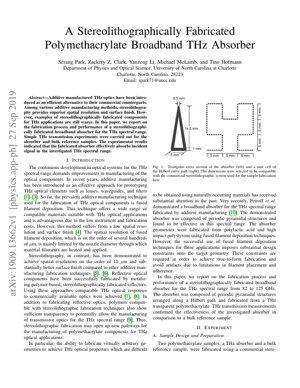
The absorber's core design is a 2D periodic array of unit cells. Each unit cell consists of a triangular (pyramidal) cross-section extruded along a third-order Hilbert space-filling curve path. This design aims to gradually increase the effective impedance from air to the polymer substrate, minimizing reflection, while the tortuous path enhances absorption through multiple internal reflections and scattering.
- Cross-section: Triangular (pyramidal) shape.
- Path: Hilbert curve (3rd order).
- Goal: Create a gradient index profile and extended interaction length for incident THz waves.
Figure Reference (Conceptual): A unit cell showing a triangular profile following a蜿蜒的 Hilbert path. The pyramid base width and height, along with the Hilbert curve's line width and spacing, are critical design parameters optimized for the target frequency band.
3.2 Fabrication Process: Stereolithography (SLA)
Samples were fabricated using a commercial Form 2 printer (Formlabs Inc.). The process involves selectively curing layers of a liquid photopolymer resin with a UV laser.
- Material: A proprietary "black" polymethacrylate resin from Formlabs, identified as sufficiently transparent in the low-THz range.
- Process: 3D model sliced into layers (~25-100 µm thickness). A UV laser traces each layer's cross-section, curing the resin. The build platform lowers, and the process repeats.
- Post-Processing: Likely involved rinsing in isopropyl alcohol to remove uncured resin and post-curing under UV light to achieve final mechanical properties.
3.3 Mathematical Formulation of Absorption
The effectiveness of an absorber is quantified by its absorption coefficient $A(\omega)$, which can be derived from transmission $T(\omega)$ and reflection $R(\omega)$ measurements, assuming negligible scattering:
$$A(\omega) = 1 - R(\omega) - T(\omega)$$
For a non-reflective backing (or sufficiently thick sample where back-side reflection is negligible), $R(\omega) \approx 0$, simplifying to $A(\omega) \approx 1 - T(\omega)$. The paper's transmission experiments measure $T(\omega)$ for the absorber and a bulk reference. The absorption is then inferred by comparing the two. The design aims to maximize $A(\omega)$ across a wide bandwidth $\Delta \omega$.
The pyramidal structure can be modeled as an impedance transformer. The effective impedance $Z_{eff}(x)$ varies along the propagation direction $x$ (from tip to base), ideally following:
$$Z_{eff}(x) = Z_0 \sqrt{\frac{\mu_{r, eff}(x)}{\epsilon_{r, eff}(x)}}$$
where $Z_0$ is the impedance of free space, and $\epsilon_{r, eff}$ and $\mu_{r, eff}$ are the effective relative permittivity and permeability, which are functions of the filling fraction of polymer at position $x$.
4. Experimental Results & Performance
4.1 THz Transmission Measurements
Simple THz transmission experiments were conducted, likely using a vector network analyzer (VNA) with frequency extenders for the 82-125 GHz range. The transmitted power through the absorber sample was measured and compared to the transmitted power through a bulk reference sample of the same polymethacrylate material and similar thickness (or through air as a baseline).
4.2 Performance Comparison & Data Analysis
The key result is that the transmitted signal through the structured absorber was significantly lower than through the bulk reference across the measured band. This indicates that the incident THz power was not simply transmitted; it was either absorbed or scattered out of the detection path. Given the design's intent and the likely measurement setup (aligned beam), the primary mechanism is absorption.
Key Experimental Finding
Observation: The SLA-fabricated absorber showed markedly reduced transmission compared to the bulk reference.
Interpretation: The pyramidal Hilbert structure successfully absorbs incident THz radiation in the 82-125 GHz band.
Implied Performance: The absorber is functional, validating the SLA fabrication approach for this class of THz component.
Chart Description (Inferred): A line chart would show transmission (in dB or normalized power) on the Y-axis versus frequency (82-125 GHz) on the X-axis. The line for the "Bulk Reference" would be relatively high and flat (high transmission). The line for the "SLA Absorber" would be significantly lower across the entire band, demonstrating broadband attenuation. The gap between the two lines represents the absorption performance.
5. Analysis Framework & Conceptual Model
To systematically evaluate such photonic devices, we propose a multi-fidelity analysis framework:
- Electromagnetic Simulation: Use Finite-Difference Time-Domain (FDTD) or Finite Element Method (FEM) solvers (e.g., Lumerical, CST Studio Suite, COMSOL) to simulate the unit cell with periodic boundary conditions. Extract S-parameters ($S_{11}$, $S_{21}$) to calculate absorption $A(f)=1-|S_{11}|^2-|S_{21}|^2$.
- Effective Medium Theory (EMT) Modeling: For initial design, approximate the graded structure as a stack of layers with varying effective permittivity $\epsilon_{eff}(z)$, calculated using the Maxwell-Garnett or Bruggeman formula for the polymer/air mixture fraction at height z. Analyze as a simple multilayer anti-reflection coating.
- Manufacturing Deviation Analysis: Import the as-designed STL file and a "as-printed" mesh (simulating SLA stair-stepping or shrinkage) back into the EM simulator. Quantify performance degradation due to manufacturing imperfections. This closes the design-manufacture loop.
- System-Level Integration Model: Place the absorber's scattering matrix into a system model (e.g., using Simulink or Python with `scikit-rf`) to evaluate its impact on overall system noise temperature or dynamic range.
Example Conceptual Code Snippet (Python - EMT Calculation):
# Conceptual function to calculate effective permittivity using Maxwell-Garnett theory
# for a composite of polymer (inclusion) in air (host).
import numpy as np

def maxwell_garnett(epsilon_inclusion, epsilon_host, volume_fraction):
    """
    Calculate effective permittivity for spherical inclusions.
    epsilon_inclusion: permittivity of polymer (e.g., ~2.5 for PMMA at THz)
    epsilon_host: permittivity of air (~1.0)
    volume_fraction: f, fraction of volume occupied by polymer (0 to 1)
    """
    numerator = epsilon_inclusion * (1 + 2*volume_fraction) + 2*epsilon_host * (1 - volume_fraction)
    denominator = epsilon_host * (2 + volume_fraction) + epsilon_inclusion * (1 - volume_fraction)
    epsilon_eff = epsilon_host * (numerator / denominator)
    return epsilon_eff

# Example: For a pyramid at a point where it's 30% polymer by volume.
f = 0.3
epsilon_polymer = 2.5 + 0.01j  # Complex permittivity, imaginary part for loss
epsilon_air = 1.0
epsilon_eff_point = maxwell_garnett(epsilon_polymer, epsilon_air, f)
print(f"Effective permittivity at f={f}: {epsilon_eff_point:.3f}")
6. Future Applications & Research Directions
- Higher Frequency Operation: Scaling the design to sub-THz and true THz frequencies (0.5-3 THz) for 6G communications and imaging. This will challenge SLA's resolution limits and require low-loss resins at these frequencies.
- Active & Tunable Absorbers: Integrating functional materials (e.g., liquid crystals, graphene inks, phase-change materials) into SLA processes to create absorbers with dynamically controllable bandwidth or absorption strength.
- Multi-Functional Metasurfaces: Using SLA to fabricate absorbers that also perform other functions, such as polarization conversion, beam steering, or spectral filtering within the same surface.
- Large-Area, Conformal Absorbers: Developing roll-to-roll or large-format SLA-like processes to create absorbers that can line the interiors of test chambers or conform to curved surfaces on vehicles or satellites for radar cross-section reduction.
- Biomedical Sensing Platforms: Creating microfluidic channels integrated with THz absorbers/antennas for lab-on-a-chip biosensors, leveraging SLA's ability to create monolithic, complex 3D structures.
- Standardization & Benchmarking: The community needs established protocols for measuring and reporting the performance of AM-fabricated THz components (e.g., under IEEE standards) to enable fair comparison and technology maturation.
7. References
- Park, S., Clark, Z. Z., Li, Y., McLamb, M., & Hofmann, T. (2019). A Stereolithographically Fabricated Polymethacrylate Broadband THz Absorber. arXiv preprint arXiv:1909.13662.
- Petroff, D., et al. (2019). [Reference to similar work on FFF absorbers].
- Formlabs Inc. (n.d.). Material Data Sheet: High-Temp Resin. Retrieved from Formlabs website. (Example of material property source).
- Withayachumnankul, W., & Abbott, D. (2009). Material Database for Terahertz Applications. International Journal of Infrared and Millimeter Waves, 30(8), 726–739. (Authoritative source on THz material properties).
- IEEE Standard 1785.1-2012: IEEE Standard for Rectangular Metallic Waveguides and Their Interfaces for Frequencies of 110 GHz and Above. (Example of relevant standards body work).
- Research groups at MIT, University of Tokyo, and Fraunhofer ITWM are known for pioneering work in additive manufacturing for RF and photonics, providing context for the field's state-of-the-art.