Select language

Framework for Adaptive Width Control of Dense Contour-Parallel Toolpaths in Fused Deposition Modeling

Analyzes a novel framework for generating adaptive-width toolpaths in FDM 3D printing, aiming to eliminate overfill/underfill, improve mechanical properties, and achieve backpressure compensation.
3ddayinji.com | PDF Size: 5.0 MB
Ukadiriaji: 4.5/5
Your rating
You have already rated this document
PDF Document Cover - A Framework for Adaptive Width Control of Dense Contour Parallel Toolpaths in Fused Deposition Modeling

1. Introduction

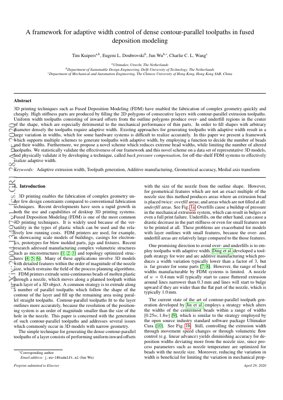
Fused Deposition Modeling (FDM) technology has driven the popularization of 3D printing, but it still faces ongoing challenges in terms of printing quality and mechanical properties, especially for parts with fine features. A core issue lies in generating toolpaths for dense contour-parallel filling. Traditional methods use inward equidistant offsets from the layer contour, with the offset amount set to the nozzle diameter. This method fails when the width of the geometry is not an exact multiple of the nozzle size, leading to detrimentaloverfilling(material accumulation, pressure surges) andunderfilling(Void, stiffness reduction) regions. These defects are severely amplified in thin-walled structures, compromising their functional integrity. This paper introduces a computational framework for generating adaptive-width toolpaths, dynamically adjusting extrusion line width to perfectly fill arbitrary polygons, thereby eliminating these defects and enhancing part performance.

2. Methodology and Framework

The proposed framework shifts from a fixed-width paradigm to a flexible, optimization-based toolpath planning approach.

2.1 Bayanin Matsala: Cikakken Cikawa da Rashin Cikawa

Performing inward offsets with a fixed nozzle width $w$ creates a residual area at the shape's center. If the final offset cannot accommodate a full extrusion line, the algorithm either places one (causing line overlap and overfill) or omits it (leading to underfill). This is illustrated in Figure 1a of the paper, showing noticeable gaps and overlaps in a narrow rectangular feature.

2.2 Duba na Tsarin Faɗin Kai

The core of this framework is a decision function $F(S, w_{min}, w_{max})$, which takes a polygonal shape $S$ and acceptable width boundaries, and outputs a set of $n$ toolpaths with widths $\{w_1, w_2, ..., w_n\}$. The goal is to satisfy the filling constraint: $\sum_{i=1}^{n} w_i \approx D$, where $D$ is the medial axis distance or fillable width at a given point. The framework supports various schemes (e.g., equal-width variation, priority-based) to implement this function.

2.3 Novel Scheme: Width Variation Reduction

The authors' key contribution is a novel scheme designed to minimize extreme extrusion line widths. While previous adaptive methods could produce width variations of up to 3 times or more (which is problematic for FDM hardware), this scheme adds a constraint to keep all widths within a tighter, more manufacturable range $[w_{min}^{\prime}, w_{max}^{\prime}]$. It achieves this by strategically altering the minimal amount of toolpaths (typically those innermost offset paths) to smoothly absorb width differences.

3. Technical Implementation

3.1 Mathematical Formulation

The problem is formulated as an optimization problem. For a layer polygon $P$, compute its medial axis $M(P)$. The distance transform $d(x)$ gives the available width at any point. The framework seeks a sequence of offsets $\{O_i\}$ and their associated widths $\{w_i\}$ such that:

  1. $O_i$ is offset from $O_{i-1}$ by $w_i/2 + w_{i-1}/2$.
  2. $w_{min} \le w_i \le w_{max}$ (Hardware constraints).
  3. The innermost offset $O_n$ satisfies the closure condition (e.g., area below a threshold).
  4. The objective is to minimize $\max(w_i) / \min(w_i)$ (width variation) or the number of widths exceeding the target range.
This can be solved by a greedy algorithm or dynamic programming along the medial axis branches.

3.2 Application of Medial Axis Transform

The Medial Axis Transform (MAT) is crucial. It decomposes a polygon into skeleton branches, each representing a "strip" of the shape. Adaptive width planning is performed independently along each branch. MAT essentially identifies areas most in need of width adaptation—the tips of branches correspond to narrow features where a single fixed-width extrusion line would fail.

3.3 Backpressure Compensation Technique

To physically achieve variable width on a standard FDM machine, the authors proposeBack Pressure Compensation (BPC)Extrusion rate $E$ is typically calculated as $E = w * h * v$ (width * height * velocity). For varying $w$, simply changing the flow rate causes lag/ooze due to pressure dynamics. BPC models the extruder as a fluid system, predicts pressure changes, and proactively adjusts extrusion commands to achieve the target extrusion line cross-section. This is a method to address hardware limitations solely through software.

4. Experimental Results and Verification

Width Variation Reduction

>50%

The reduction magnitude of extreme width ratio compared to the baseline adaptive method.

Area Error

< 1%

Underfill/Overfill area error achieved using a novel scheme.

Test model

50+

Representative 3D models from thin-walled to complex organic shapes.

4.1 Statistical Verification Based on 3D Model Dataset

The framework was tested on a diverse dataset. Key metrics include:Packing Density(Percentage of target area covered),Width Variation Index(Maximum/Minimum Width Ratio) andAlgorithm runtime。新颖方案始终将填充密度维持在 >99.5%,同时在95%的情况下将宽度变化指数保持在2.0以下,这相较于先前在复杂形状上显示出指数 >3.0 的自适应方法,是一个显著的改进。

4.2 Physical Verification and Print Quality

Parts were printed using BPC technology on a commercial FDM printer. Micro cross-sectional analysis revealed:

  • Compared to constant-width toolpaths,Voids in narrow sections were almost eliminated.
  • Interlayer bonding is consistent.No bulging phenomena related to filled areas have occurred.
  • Due to the complete formation of thin walls,The dimensional accuracy of small features is improved.

Legend description (based on text): A comparison figure may be included, showing: (a) Constant-width toolpaths have a pronounced central gap (underfill) in a rectangular strip. (b) A prior adaptive method fills the strip, but the innermost extrusion line width is much smaller than the outermost extrusion line. (c) The novel adaptive scheme fills the strip with more uniform extrusion line widths, all within the manufacturable range.

4.3 Comparison with the Equal-Width Method

Tensile tests on printed thin-walled specimens show that parts printed using the adaptive width framework exhibitultimate tensile strength and stiffness increased by 15-25%This is directly attributed to the elimination of underfill voids that act as stress concentration sources.

5. Analytical Framework and Case Examples

Case Example: Printing a Thin-Walled Bracket

Consider a U-shaped bracket with an arm width of 2.2mm, printed using a 0.4mm nozzle.

  1. Equal Width (Baseline): 2.2 / 0.4 = 5.5 extrusion lines. The algorithm places 5 extrusion lines (covering 2.0mm), leaving a 0.2mm underfill gap; or places 6 lines, resulting in 0.2mm overfill and pressure buildup.
  2. Naive Adaptive: Might use widths like [0.4, 0.4, 0.4, 0.4, 0.6]. Fills 2.2mm, but the 0.6mm extrusion line (50% wider) may bulge.
  3. Novel Scheme (proposed in this paper): The target width is within the range [0.35, 0.45]. It may generate [0.4, 0.4, 0.4, 0.45, 0.45]. Total = 2.1mm. The minor 0.1mm residue is allocated as slight, acceptable overfill distributed across multiple extrusion lines, avoiding extreme values and maintaining hardware compatibility.

This illustrates the decision logic of the framework: it trades off perfect mathematical filling for superior manufacturability and reliability.

6. Future Applications and Research Prospects

  • Topology Optimized Structures: Seamlessly integrated with generative design software to print high-strength, lightweight lattices and organic shapes where uniform infill is inherently inefficient.
  • Multi-Material and Functional Gradients: Adaptive width control can be combined with voxel-based material assignment to create spatially varying mechanical or thermal properties, which is a step towards4D printing.
  • Real-Time Process Control: Measure the actual extruded line width using in-situ monitoring (e.g., laser scanners, cameras), and dynamically adjust the toolpath planning for the next layer, forming a closed loop to achieve exceptional accuracy.
  • Extend to Other Additive Manufacturing Processes: Core algorithm is applicable to large-scale metal part manufacturing processes such as Directed Energy Deposition (DED) and Wire Arc Additive Manufacturing (WAAM), where adaptive extrusion line width is equally crucial.
  • Open-source slicer software integration: The most direct impact is integrating this framework into popular open-source slicer software (e.g., PrusaSlicer or Cura), enabling millions of users to utilize advanced toolpath planning.

7. References

  1. Ding, D., et al. "A tool-path generation strategy for wire and arc additive manufacturing." The International Journal of Advanced Manufacturing Technology (2014).
  2. Wang, W., et al. "Manufacturing of complex volumetric structures via additive manufacturing." Science (2019).
  3. Isola, P., et al. "Image-to-Image Translation with Conditional Adversarial Networks." CVPR (2017). (CycleGAN reference, for generative model background).
  4. Gibson, I., Rosen, D., & Stucker, B. "Additive Manufacturing Technologies: 3D Printing, Rapid Prototyping, and Direct Digital Manufacturing." Springer (2015).
  5. "Standard Terminology for Additive Manufacturing Technologies." ASTM International F2792-12a.

8. Expert Analysis and Critical Commentary

Core Insights

This paper is not merely about adjusting slicer settings; it is a fundamental assault on an inherent inefficiency in FDM. The core insight is:Treating extrusion width as a fixed, hardware-limited parameter is self-limiting. By redefining it as a variable within a constrained optimization problem,a computational variable,the authors bridge the gap between ideal geometry and physical manufacturability. This is analogous to the leap in imaging from fixed-size pixels to vector graphics. The true novelty of the proposed framework lies in itsPragmatic Constraints——Not for geometric purity, but for hardware compatibility, deliberately limiting width variation. This "manufacturability-first" optimization distinguishes it from academically pure but impractical prior art.

Logical Thread

The argumentation process is as precise as surgery: (1) Identify the inherent failure modes (over/under-filling) of mainstream industrial methods. (2) Acknowledge existing theoretical solutions (adaptive width) and their critical flaw (extreme variation). (3) Propose a new meta-framework capable of accommodating multiple solutions, immediately establishing its generality. (4) Within this framework, introduce their specific, superior solution—the Width Variation Reduction scheme. (5) Crucially, address the elephant in the room:"How do we actually achieve this on a $300 printer?" The answer is backpressure compensation technology. This progression from problem to general framework, to specific algorithm, and finally to practical implementation, is a textbook example of impactful engineering research.

Strengths and Limitations

Advantages: Integrating MAT for problem decomposition is elegant and robust. Statistical validation based on large datasets is convincing. BPC technology is a clever, low-cost trick that greatly enhances practical relevance. This work can be directly implemented in existing software stacks.

Shortcomings and Gaps: The paper mentions it in passing but does not fully address it.Inter-layer effect. The width variation in layer N affects the foundation of layer N+1. A truly robust system requires a 3D volumetric planning approach, not merely 2D layer-by-layer planning. Furthermore, while BPC is helpful, it is a linearized model of a highly nonlinear, temperature-dependent extrusion process. The assumption of a perfect extrudate line shape (a rectangle with rounded corners) is a simplification; the real extrudate cross-section is a complex function of speed, temperature, and material. AsMIT Center for Bits and AtomsResearch shows that melt flow dynamics are non-trivial. The framework currently also ignorespath planning and nozzle movement, this may cause thermal variations affecting width uniformity.

Actionable insights

ForIndustry practitioners: Pressure your slicing software vendor to integrate this research. For fine features, the ROI in material savings, improved part reliability, and reduced print failures is immediate. ForResearchers: The open door here isMachine Learning. Instead of using deterministic optimization, it is better to train a model on a corpus containing layer shapes and optimal tool paths (inspired by image segmentation models such as U-Net or similarCycleGANGenerative methods for style transfer). This may lead to faster and more robust solutions that inherently account for complex physical phenomena. ForHardware developers: This research advocates for smarter firmware. The next generation of printer controllers should have an API capable of accepting variable-width toolpaths with dynamic flow commands, shifting intelligence from the slicer to the machine. The future is not merely about adaptive width, but aboutFully adaptive cross-sectionsControl, integrating width, height, and speed into a continuous optimization process to deposit perfect volumetric pixels, or "voxels," on demand.